AI is getting more and more impressive, and it is downright astounding to see things that have been in my own head come to life with fewer and fewer uncanny issues! This week I got into using the DALL-E AI image generator at bing.com/create, which is free and very impressive! (in short, the only thing I'll ever use Bing for). With its impressive grasp of descriptions, I was able to breathe new life into the gods of my fantasy settings once again.

Showing posts with label argaenothruzil. Show all posts
Showing posts with label argaenothruzil. Show all posts
Dec 19, 2023
Apr 27, 2022
Artifacts of Argaenothruzil 5e
There aren't a lot of magic items established in Argaenothruzil lore, unfortunately, but these are the ones I gleaned from the existing publications I still have access to.
Apr 26, 2022
Devils of Argaenothruzil (Gods part 3)

Rauroth
God of Vengeance
Rauroth the Burning One is the god of revenge, fury, lust, and fire. The sun is often called Rauroth's Eye when it is shining particularly hot in the summer or in deserts. He is the patron god of gogs who embrace their fiendish parentage. Rauroth's name is most often invoked as an expletive when in rage, and to lose one's own mind to strong emotions and passions is to worship the Burning One.
Rauroth is depicted as a red-eyed man engulfed in flames.
Apr 25, 2022
Gods of Argaenothruzil 5e (Part 2)

Bezzoan
God of Honor
Bezzoan Iron-Fists is the god of warmth, courage, and righteous triumph in battle. He is the patron god of sailors, particularly those of the sea kingdom of Vingomir, and the first creator of humans. Mortals pray to Bezzoan to preserve their family lines and to protect their homelands, but he mainly acts through inspiring mortals to help themselves, rather than intervening directly. It gives him pleasure to see weakness become strength and for shivering folks to learn to stand strong and resolute.
Bezzoan is depicted as a black-bearded man with fists made of wrought iron.
Apr 23, 2022
Gods of Argaenothruzil 5e (Part 1)
Nine Intelligences came into being at the birth of the cosmos, and they worked together to create the world of Argaenothruzil. They all created races of the world, but disputes over the purpose of these "blood-children" led to a division. Half of the planet was corrupted beyond redemption, and three of the Intelligences became Devils while the other six became Gods. All nine deities continue to influence Argaenothruzil and the progress of its history in various ways.

Apr 22, 2022
Races of Argaenothruzil 5e
Though they have more locally divine origins, for the most part, the races of Argaenothruzil resemble those on other worlds in the multiverse. The halflings were made out of clay and the dwarves out of stone by the God of Fortune, Moeki; the elves from trees by Phroella; the gnomes from snow and the genies from sand by Henaeros; and the orcs from lava by D'nethrokash the Destroyer. Humans were created from the dust of the earth by all the gods.
But other races exist that are unique to Argaenothruzil, and others have variations due to Argaenothruzil's unique cultures and climate that will be listed here as well. The races and their changes, if any, are listed in alphabetical order below. The more unique races to Argaenothruzil have more details.
Apr 21, 2022
Argaenothruzil 5e
I've been thinking a lot about different D&D settings lately and what makes them unique. Dark Sun is a post-apocalyptic setting where magic is destructive and halflings have become cannibalistic; Theros is based on Greek mythology where destiny determines your path, the gods are close to mortals and directly affect the world, and heroes adventure for glory itself; Spelljammer is basically D&D in space; Planescape jumps all over the planes of existence; Ravenloft is Gothic horror; Rokugan is Asian wuxia; I'm not really sure what Eberron is, something about noir and robots?
Anyway, with the release of Chris Metzen's Auroboros: Coils of the Serpent campaign that's literally just his own homebrew setting he made as a teenager in published form, I've thought about my own first setting I roleplayed in before I even knew about D&D: Argaenothruzil.
Feb 28, 2021
Eden: Argaenothruzil Re-imagined
Have I got a crazy story for you.
Remember this map that I posted on here two years ago after making it? I forgot that I did this, but I posted that map online on the Inkarnate database just for other people to see it. Little did I know that this map would be the inspiration for an alternate reality of Argaenothruzil born in the head of a completely different person!
A guy named Nitsuj (presumably Justin, which is an oddly similar name to mine as well) wanted to create a homebrew D&D world but lacked the skills to make a world map, so he looked around online. He stumbled upon my map on a Pinterest board and decided to use it as a base to craft his world, "Eden," around. He made up backstories and lore for each location on the map and build a large group of people (West Marches style) on his Discord channel.
He eventually deep-searched me looking for the creator of the map and showed me his work. It was crazy to introduce myself to his players as the original creator of the map they all played D&D on, and weirder still to hear the stories he came up with for each location. Below are the locations and the differences between them in this shadow-world of his:
Apr 6, 2020
Argaenothruzil Creation of the World Poem Parchment
I was going through my documents and found a lot of material I wrote about Argaenothruzil. As much as I like writing stuff for my newer, more D&D DMG-helped-along setting, Hearth, Argae will always hold a special place in my heart, and sometimes I forget just how much work I put into its worldbuilding.
This parchment, the text of which can be red here, is based on the original Anglo-Saxon manuscript found of Beowulf. The poem uses kennings and alliterative verse to tell the story, just like Beowulf does, and it does so surprisingly well. I've noticed that it takes about 5 years to appreciate something anew, and I'm really impressed with this project.
This parchment, the text of which can be red here, is based on the original Anglo-Saxon manuscript found of Beowulf. The poem uses kennings and alliterative verse to tell the story, just like Beowulf does, and it does so surprisingly well. I've noticed that it takes about 5 years to appreciate something anew, and I'm really impressed with this project.
Mar 13, 2018
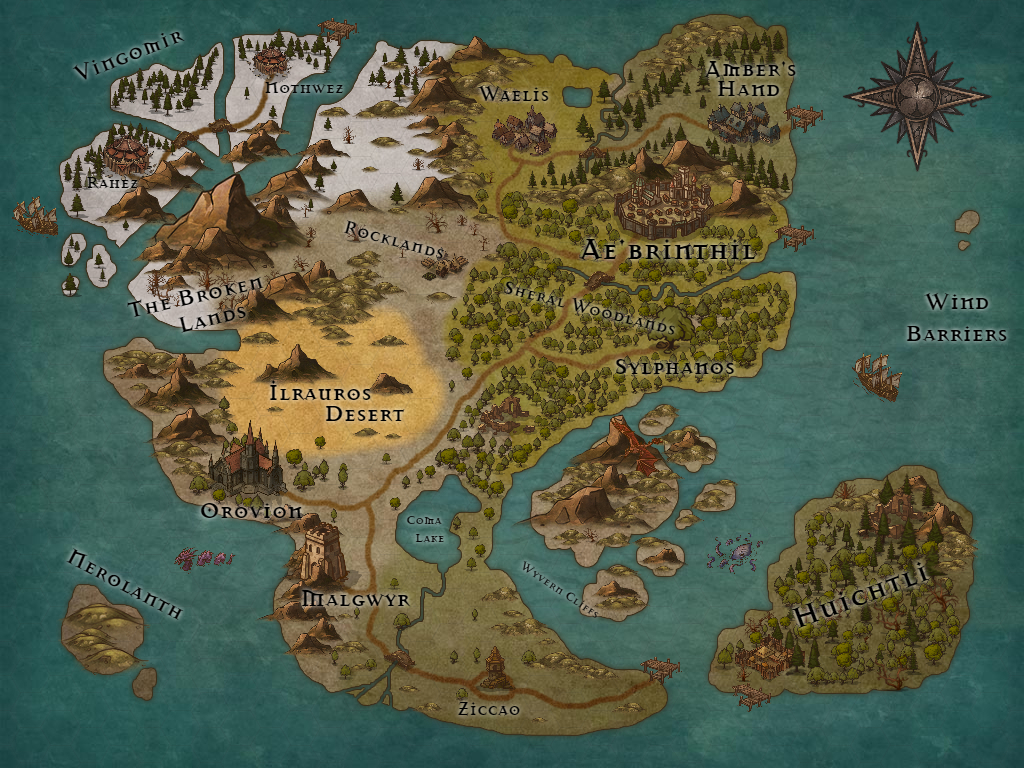
Inkarnate Argaenothruzil Map
I've been looking into all the D&D dungeon-mastering resources I can find (and brainstorming ideas for custom ones I could make someday) lately, and came across this nifty map making program Inkarnate. Naturally, I decided to adapt Argaenothruzil to it. I think it turned out great, though their workspace is extremely small... I ended up having to warp the map considerably and not even have enough room for the word 'Argaenothruzil' at the top or anything like that. The pro version apparently lets you make enormous maps. If I ever get enough money for a subscription, who knows? I may look into that.

Oct 22, 2015
Argaenothruzil Map
My cousin and I are finally at the end of our long road of writing, editing, fixing, and compiling Alfred Shortstaff and the Cavern of Time, and it will soon be published and available for purchase online! For this project, I had to remake the map of Argaenothruzil I originally used in the forum. I decided to take a professional approach, complete with penciling, inking, and labeling on Photoshop. The only thing I regret not doing is putting a border around it; I also forgot that my book would not be a 9" x 11" dimension, for which I feel stupid... so I can only hope that the printed version will do the image justice and not warp it or cut any parts off.
Jul 28, 2015
Alfred Deleted Scene: The Crusade
My cousin and I have been working our tails off prepping Alfred Shortstaff and the Cavern of Time for publication after almost ten years of writing and editing and development hell. This was a scene that I wrote describing an event canonical to Argaenothruzil history, which was included in the original draft. However, we couldn't make it work with the way the story turned out, so we had to cut it. Still, I like the way the prose turned out, and it's been a while since I was able to explore the Argae universe since it died months ago. So, for your reading enjoyment, here is the cut prologue of Alfred Shortstaff.
Jul 24, 2015
The Wonder of Magic
I thought that this document had "gone down with the ship" when the Argaenothruzil site vanished, but I luckily saved a copy on my computer! Thank you, past self! It's a description of how magic works in Argaenothruzil, which was something that I wrote with a lot of thought put into it.
Sep 16, 2014
Nadrian Diplomacy: Argae's Ancient Precursor
The other day I was backing up stuff to my external hard drive, The Ark, when I stumbled upon my original profile folder for my old computer when I was a kid. Back then, every person in the family didn't have his or her own laptop, so we all shared one home PC. We sometimes had our own computer accounts, with passwords and everything, but mostly we just shared one profile for simplicity's sake, and had our own folders. Mine, "Austin's Folder" has been virtually preserved from its original state when it was uploaded to an external hard drive back in 2004.
As I looked through the folder, I was surprised and interested to see a folder labeled "Nadrian Diplomacy." It was an unfinished web-based game I had started a decade ago, and the pictures, compiled web pages, and forms in the folder brought back a lot of memories. It was fun to see the broken remnants of a project I had never finished, yet had reincarnated into a large universe in the form of Argaenothruzil years later. It was interesting to see the seeds that had planted such big projects.
So without further reminiscing, here is an overview of the RPG that never was,
As I looked through the folder, I was surprised and interested to see a folder labeled "Nadrian Diplomacy." It was an unfinished web-based game I had started a decade ago, and the pictures, compiled web pages, and forms in the folder brought back a lot of memories. It was fun to see the broken remnants of a project I had never finished, yet had reincarnated into a large universe in the form of Argaenothruzil years later. It was interesting to see the seeds that had planted such big projects.
So without further reminiscing, here is an overview of the RPG that never was,
Nadrian Diplomacy:
The War Has Begun
Jan 6, 2014
The Creation of the World poem
I've been working on this for a while. With my exposure to Anglo-Saxon poetry, I decided to follow their patterns of alliteration to make my own. This is now an official canonical piece of Argaenothruzilian lore on my forum. For the original story I based this on, see this post.
Nov 26, 2013
A couple of surprises
On Hearthstone, there are special "golden" cards that are animated with special effects. Besides that and their higher worth/cost, they're just the same as normal cards. But I like them. Anyway, I decided to try my hand at making my own on Adobe Premiere. These are three gods from the Argae mythos. They're really low resolution because I wanted to use them on my Argae forum, but it turns out they're too big to put as avatars anyway. Go figure. Oh well. A fun idea and a nice gateway experiment for making GIFs.


Sep 6, 2013
Argaenothruzil Classic
Today I stumbled upon an old email in my archives that was a message to myself containing a single link: http://pub45.bravenet.com/forum/static/show.php?usernum=3860195469&frmid=6335.
This link leads to Argaenothruzil Classic, the original forum that my friends and I used to start our stories. It's been really fun for me to look over how the somewhat vast mythos of Argaenothruzil began as the simplest of universes. The races seem cliché simply because they began that way as meaningless lists of adjectives. Now at least they have backstories, cultures, and geographic locations.
This link leads to Argaenothruzil Classic, the original forum that my friends and I used to start our stories. It's been really fun for me to look over how the somewhat vast mythos of Argaenothruzil began as the simplest of universes. The races seem cliché simply because they began that way as meaningless lists of adjectives. Now at least they have backstories, cultures, and geographic locations.
Aug 7, 2013
Abelhawk the Archmage

This one didn't turn out as good as the other one color-wise, but I liked doing it just the same. This is the fictional character whose name I use in everything, as I best imagine him in my books. Strictly speaking, this drawing is based on his Argaenothruzil incarnation in the present era.
Jul 26, 2013
Vilhellm Xonafitii

I got in the mood to draw today, so I drew the protagonists of the current story I'm writing with my cousin. This first one is my character, Vilhellm "Will" Xonafitii. One thing you should know about my own mythos, Argaenothruzil, is that though it uses lots of cliches (such as elves, dwarves, and vampires), it does so so that I as the writer can interpret them in my own way. In a sense, it's a sort of my fanfiction of classic fantasy.
Will is a wampyre, a recently discovered race (for mainland Argaenothruzil) from Nerolanth. Wampyres in my universe are not bloodthirsty monsters. They are simply another race in the world. They are a nocturnal race, mainly because their skin is sensitive to the sun; their eyes can range from red and orange to pink and magenta in color; they only drink blood from animals, and some even drink the juice from fruits. They are a vain race who value their family lines, ingenuity, and written works.
Will himself spent some of his childhood in mainland Argaenothruzil, so he learned to speak Argaen without a Nerolanthian accent. His main goal in the story is to travel to Argae and become a part-time diplomat and a full-time artifact hunter. He meets Zenaeron, my cousin's character, and they set off together to go on adventures. You can read the story as it stands thus far here, and it's a work in progress, so we're adding to it almost daily.
I'll upload other pictures soon!
Jul 19, 2013
The Creation of the World
I've been slacking on projects due to an especially enthusiastic playthrough of Oblivion, so here's a filler: A look into the world of Argaenothruzil (my play-by-post forum RPG) and its creation.
Before the world existed, there was only Void. Matter chaotically flowed through the infinite Void with no reason to do anything else. The only life in the entire universe were the Intelligences. The Intelligences were beings that resembled what humans would later become. They knew the balance of the cosmos and how, more or less, to control it. There were many Intelligences, but nine in particular had great leadership skills amongst the rest
It became meet in time for the Intelligences of the cosmos to organize the matter in the universe and pass on their lineage to lesser beings, mortals. All of the Intelligences agreed that the population of mortals they created should appear in their own image, but before they could create life, they would have to create a world on which their denizens could live. From the matter scattered across the infinite Void, they sorted out five important elements: Fire, Water, Earth, Air, and Quintessence.
Quintessence was the same substance that flowed through the veins of the Intelligences. They used this godly essence to construct the countless stars in the sky.
From Earth, the Intelligences created planets, moons and other bodies of rock to serve as the solid representation of matter in the universe. They especially made great care to form the World on which they planned to let their heirs inhabit.
They used the element Fire to create a yellow Sun to warm their new world. Some Fire was also used within the world itself and other planets.
 Water was used mostly for the seas and oceans of the world, but some Water was frozen and wrapped around stars called comets.
Air was useless to the Intelligences, but they created with it a bubble of pure Air around the world in hopes that their inferiors could use it to sustain their mortal life.
Having now a mortal world on which to extend their children’s lives, the Intelligences created a race of strong, healthy humans from the dirt on which they were destined to stand. The Intelligences also created many different animals and plants to accompany them. To make the mortal lives begin, the Intelligences inserted into their veins the most special of all their creations, blood. This sacred fluid was the epitome of the Intelligences’ love for their children.
At this time, the Intelligences of the cosmos reached an argument. What would the human race’s objective in life be? The nine head Intelligences each had a different point of view for the mortal race, but they were divided into three main viewpoints. One group believed that the human race should want to help each other and work together. Another believed that they should work only for their own pride and self-accomplishment. Still another believed that both of the others were wrong, and that something in-between should be achieved, something balanced, like the way in which the world was created.
At last, most of the Intelligences agreed that all of the various viewpoints would be present in their world of men, and that a compromise should be made. But some of the Intelligences were deeply offended and demanded that their way should be the only one present. At this point, the Intelligences made a “Great Division” within themselves. Two-thirds of the nine became known as Gods, hoping for the well-being of the world, and one third became known as Demons, hoping for the possible destruction of what they had just helped create. The latter group and its followers were driven out of the council and shunned.
The world was made up of two continents: Argaenothruzil(or “Gods’ Crown”) and Elidethnar(or “Noble Diamond”). After the Great Division, the Demons attempted at once to seize control of the world for their own practices. The Gods and their army of Angels outnumbered the cowardly Demons, and succeeded in saving Argaenothruzil from their evil taint. Unfortunately, the dark grasp of the Demons held fast to the latter continent of Elidethnar. The continent was corrupted beyond the Gods’ control of it. Before the blight could spread, the Gods decided to use their remaining element of Air to thwart the Demons’ plan. With their remaining supply of element Air, the Gods conjured massively violent storms surrounding the corrupt island in hopes that none of their noble children on Argaenothruzil would be touched by its dark influence. The storms successfully ceased the Demons’ invasion, but the humble continent of Elidethnar was lost. The Gods’ children there were no longer in the safety of their influence. Only a small part of their power could occupy them any longer. The Demons rejoiced in their taking of the entire continent to their own. They renamed the continent Eredathios, meaning “Black Possession.”
To this day the Gods extend their help to their beloved blood-children in hopes that they can sustain the order of the world, but not all of their heirs held fast to the feelings of Good in their hearts. Many let their ungodly passions corrupt their own minds and become under the Demons’ influence, and some even lost the love of order altogether, and sought to aid their Demon lord masters. However, most of the blood-children adhere to the standards set by their divine creators, even through the much evolution the world’s population has gone through, to the splitting of races besides pure humans. In many societies, they construct magnificent temples in worship to the Gods. Although, of course, there are those gullible and weak-minded who spill their own precious god-given blood in sacrifice to Demons as well. The Nine Deities and their alignments are as follows:
 Vendictes: The most pure of the Gods, Vendictes dwells in the hearts and minds of the blood-children in hopes that he can guide them in their thoughts to what is right in their lives and the lives of others. He is always with those who are Virtuous.
 Phroella: Known as the Nature Mother by some, Phroella is always anxious to use her argument-quelling powers to settle the various disputes among men. She is the Goddess of sympathy, regret, and forgiveness, and the Goddess of Peace.
 Bezzoan: The noblest God is by far Bezzoan, who puts determination and fervor into the hearts of his blood-children. He is a warrior God, but not a bloodthirsty one. He is revered by those who value their Honor above all else.
 Henaeros: The wisest of the Gods and the organizer of the world’s creation, it was Henaeros who protected Argaenothruzil from the steady corruption of Eredathios. Henaeros is the God who never changes, and he believes that the world should be that way as well. Henaeros is the God of Order.
 Ezrim: Ezrim, who esteemed the Demons’ actions intolerable in comparison to the Gods’, chose to join their order. He was the founder of the cities and governments of Argaenothruzil and gave the kings of such cities divine right to rule. Those who seek Justice are favorites of Ezrim’s.
 Moeki: Moeki was actually one of the Intelligences who proposed a selfish race of humans, but in seeing his comrades the Demons outnumbered in vote joined the Gods instead. He is a cunning, sneaky God, and he still believes deep down that the favor of others is ultimately important. Those who seek Fortune worship Moeki in particular.
 Rauroth: Perhaps the most quick-tempered of the Demons, Rauroth’s entire being is consumed in hatred for the Gods and his banishment from their council. Those of the world who find themself in a similar vengeful state of mind will find themself growing closer to the influence of Rauroth, the Demon of Revenge.
 Khlamul: Followers of Khlamul are rarely religious, busying themselves entirely in the workings of science and knowledge, in hopes of dominating others. He was among one of the more missed of the council, as his lust for knowledge was rivaled only by Henaeros. Now he sees no other way to defeat the Gods than to overtake them by making himself more Powerful than they.
 D’nethrokash: The most evil of all the Demons, it was D’nethrokash the Corrupter who succeeded in obtaining Eredathios from the Gods’ control. He is the Demon of Chaos, and seeks to destroy everything that he does not control. Many of the citizens living on the Eredathios continent were driven mad with his dark energies, but his influence extends to a small number of individuals in Argaenothruzil as well.
By way of commentary (so this post isn't a complete cop-out), I think it's interesting how I made this up without too much thought, but that certain archetypes seen in other stories apply here. For example, just like in the Elder Scrolls mythos, there are Nine "Divines," though admittedly three became evil. This is also an interesting allusion to LDS theology, in that "a third" of the hosts of heaven chose Satan's plan over God's.
I also, if you notice, tried to add variety to the Deities' names by making each one have a different beginning sound and ending sound.
Bonus points for whoever can comment and guess who the actors are I used to portray them.
I HATE the actor I had to choose for Vendictes, but that is literally the only picture I could find that remotely resembled the god I imagined in my head. If anyone knows of an older actor who has a beard and a benevolent smile, please let me know.
The Creation of the World
It became meet in time for the Intelligences of the cosmos to organize the matter in the universe and pass on their lineage to lesser beings, mortals. All of the Intelligences agreed that the population of mortals they created should appear in their own image, but before they could create life, they would have to create a world on which their denizens could live. From the matter scattered across the infinite Void, they sorted out five important elements: Fire, Water, Earth, Air, and Quintessence.
Quintessence was the same substance that flowed through the veins of the Intelligences. They used this godly essence to construct the countless stars in the sky.
From Earth, the Intelligences created planets, moons and other bodies of rock to serve as the solid representation of matter in the universe. They especially made great care to form the World on which they planned to let their heirs inhabit.
They used the element Fire to create a yellow Sun to warm their new world. Some Fire was also used within the world itself and other planets.
 Water was used mostly for the seas and oceans of the world, but some Water was frozen and wrapped around stars called comets.
Air was useless to the Intelligences, but they created with it a bubble of pure Air around the world in hopes that their inferiors could use it to sustain their mortal life.
Having now a mortal world on which to extend their children’s lives, the Intelligences created a race of strong, healthy humans from the dirt on which they were destined to stand. The Intelligences also created many different animals and plants to accompany them. To make the mortal lives begin, the Intelligences inserted into their veins the most special of all their creations, blood. This sacred fluid was the epitome of the Intelligences’ love for their children.
At this time, the Intelligences of the cosmos reached an argument. What would the human race’s objective in life be? The nine head Intelligences each had a different point of view for the mortal race, but they were divided into three main viewpoints. One group believed that the human race should want to help each other and work together. Another believed that they should work only for their own pride and self-accomplishment. Still another believed that both of the others were wrong, and that something in-between should be achieved, something balanced, like the way in which the world was created.
At last, most of the Intelligences agreed that all of the various viewpoints would be present in their world of men, and that a compromise should be made. But some of the Intelligences were deeply offended and demanded that their way should be the only one present. At this point, the Intelligences made a “Great Division” within themselves. Two-thirds of the nine became known as Gods, hoping for the well-being of the world, and one third became known as Demons, hoping for the possible destruction of what they had just helped create. The latter group and its followers were driven out of the council and shunned.
The world was made up of two continents: Argaenothruzil(or “Gods’ Crown”) and Elidethnar(or “Noble Diamond”). After the Great Division, the Demons attempted at once to seize control of the world for their own practices. The Gods and their army of Angels outnumbered the cowardly Demons, and succeeded in saving Argaenothruzil from their evil taint. Unfortunately, the dark grasp of the Demons held fast to the latter continent of Elidethnar. The continent was corrupted beyond the Gods’ control of it. Before the blight could spread, the Gods decided to use their remaining element of Air to thwart the Demons’ plan. With their remaining supply of element Air, the Gods conjured massively violent storms surrounding the corrupt island in hopes that none of their noble children on Argaenothruzil would be touched by its dark influence. The storms successfully ceased the Demons’ invasion, but the humble continent of Elidethnar was lost. The Gods’ children there were no longer in the safety of their influence. Only a small part of their power could occupy them any longer. The Demons rejoiced in their taking of the entire continent to their own. They renamed the continent Eredathios, meaning “Black Possession.”
To this day the Gods extend their help to their beloved blood-children in hopes that they can sustain the order of the world, but not all of their heirs held fast to the feelings of Good in their hearts. Many let their ungodly passions corrupt their own minds and become under the Demons’ influence, and some even lost the love of order altogether, and sought to aid their Demon lord masters. However, most of the blood-children adhere to the standards set by their divine creators, even through the much evolution the world’s population has gone through, to the splitting of races besides pure humans. In many societies, they construct magnificent temples in worship to the Gods. Although, of course, there are those gullible and weak-minded who spill their own precious god-given blood in sacrifice to Demons as well. The Nine Deities and their alignments are as follows:
Vendictes: The most pure of the Gods, Vendictes dwells in the hearts and minds of the blood-children in hopes that he can guide them in their thoughts to what is right in their lives and the lives of others. He is always with those who are Virtuous.Phroella: Known as the Nature Mother by some, Phroella is always anxious to use her argument-quelling powers to settle the various disputes among men. She is the Goddess of sympathy, regret, and forgiveness, and the Goddess of Peace.Bezzoan: The noblest God is by far Bezzoan, who puts determination and fervor into the hearts of his blood-children. He is a warrior God, but not a bloodthirsty one. He is revered by those who value their Honor above all else.Henaeros: The wisest of the Gods and the organizer of the world’s creation, it was Henaeros who protected Argaenothruzil from the steady corruption of Eredathios. Henaeros is the God who never changes, and he believes that the world should be that way as well. Henaeros is the God of Order.Ezrim: Ezrim, who esteemed the Demons’ actions intolerable in comparison to the Gods’, chose to join their order. He was the founder of the cities and governments of Argaenothruzil and gave the kings of such cities divine right to rule. Those who seek Justice are favorites of Ezrim’s.Moeki: Moeki was actually one of the Intelligences who proposed a selfish race of humans, but in seeing his comrades the Demons outnumbered in vote joined the Gods instead. He is a cunning, sneaky God, and he still believes deep down that the favor of others is ultimately important. Those who seek Fortune worship Moeki in particular.Rauroth: Perhaps the most quick-tempered of the Demons, Rauroth’s entire being is consumed in hatred for the Gods and his banishment from their council. Those of the world who find themself in a similar vengeful state of mind will find themself growing closer to the influence of Rauroth, the Demon of Revenge.Khlamul: Followers of Khlamul are rarely religious, busying themselves entirely in the workings of science and knowledge, in hopes of dominating others. He was among one of the more missed of the council, as his lust for knowledge was rivaled only by Henaeros. Now he sees no other way to defeat the Gods than to overtake them by making himself more Powerful than they.D’nethrokash: The most evil of all the Demons, it was D’nethrokash the Corrupter who succeeded in obtaining Eredathios from the Gods’ control. He is the Demon of Chaos, and seeks to destroy everything that he does not control. Many of the citizens living on the Eredathios continent were driven mad with his dark energies, but his influence extends to a small number of individuals in Argaenothruzil as well.
__________________________________
By way of commentary (so this post isn't a complete cop-out), I think it's interesting how I made this up without too much thought, but that certain archetypes seen in other stories apply here. For example, just like in the Elder Scrolls mythos, there are Nine "Divines," though admittedly three became evil. This is also an interesting allusion to LDS theology, in that "a third" of the hosts of heaven chose Satan's plan over God's.
I also, if you notice, tried to add variety to the Deities' names by making each one have a different beginning sound and ending sound.
Bonus points for whoever can comment and guess who the actors are I used to portray them.
I HATE the actor I had to choose for Vendictes, but that is literally the only picture I could find that remotely resembled the god I imagined in my head. If anyone knows of an older actor who has a beard and a benevolent smile, please let me know.
Subscribe to:
Posts (Atom)